
A lightweight guilloché bracelet can look much like a heavier version from the front. The important question is what was made thinner to reach that weight. If a lower gold budget means less metal at the retaining prongs, the small parts holding a patterned insert can become a weak point. A damaged prong can leave the insert loose and, ultimately, allow it to fall out.
This guide examines a reported prong problem on a 12.5g five-motif guilloché bracelet, supplied by the Justes team. It explains how to compare a lighter build with the roughly 15g versions we encounter, what a weight comparison can tell you, and which details deserve a closer inspection before ordering.
About this comparison: the case photograph and weight observations come from Justes. They are not a laboratory failure study or official brand specifications. Justes is independent and is not affiliated with Van Cleef & Arpels; brand references identify the design discussed in the linked sources.
The 12.5g case: a small retaining point matters
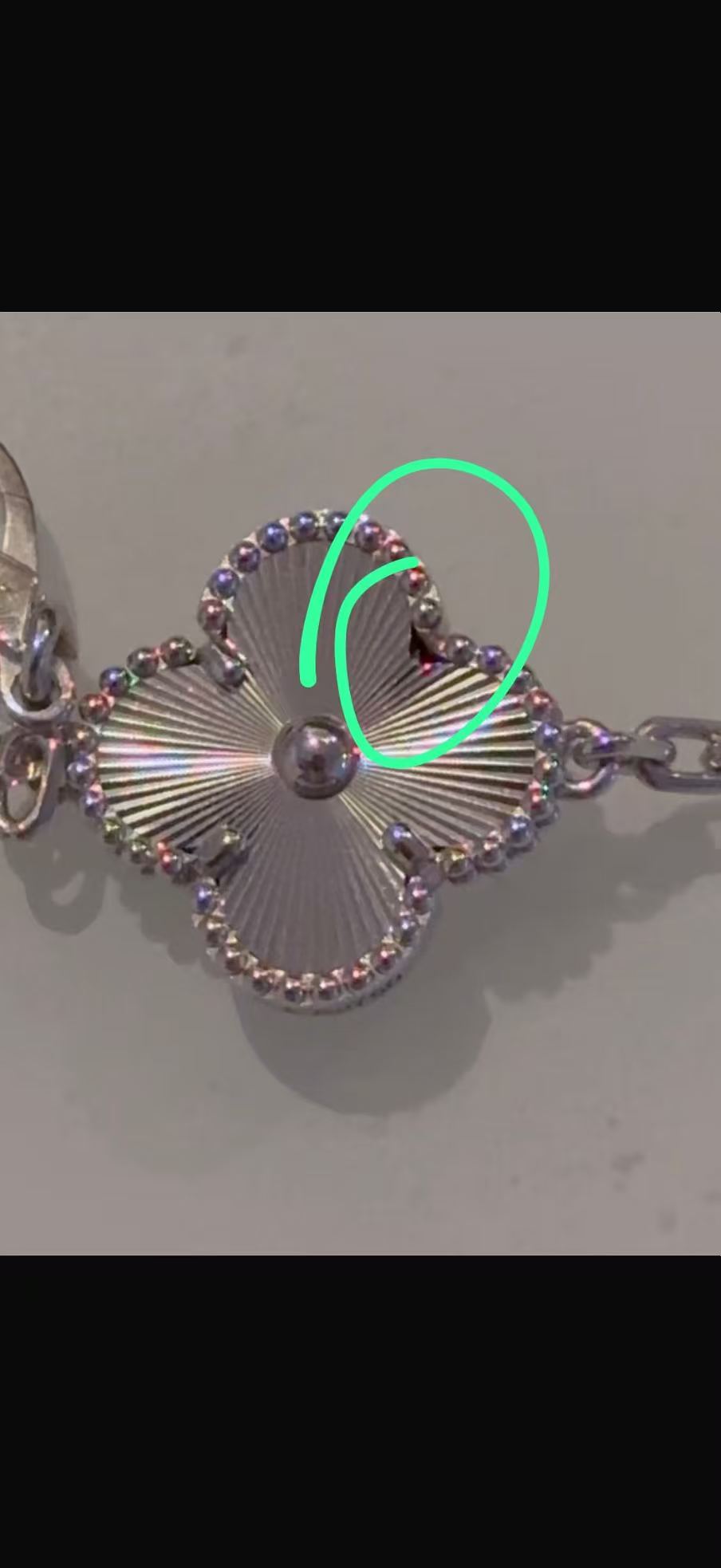
The team identified this as a light-gold version weighing approximately 12.5g and reported a broken retaining prong. The concern is the security of the separate guilloché insert: once a retaining point fails, the remaining setting may no longer keep that insert firmly in position.
The photograph helps locate the problem, but it cannot establish the metal alloy, precise prong thickness, wear history or cause of fracture. Those questions require examination of the actual piece. It also does not establish a failure rate for every bracelet at this weight.
12–12.5g, around 15g and around 17g: what are we comparing?
In Justes’ supplier-side experience, versions around 15g are a familiar comparison point for this style. We also encounter versions around 12–12.5g offered to meet a lower production cost or customer budget. These are observations from our work, not a measured survey of the entire market.
| Weight reference | Basis for the figure | How to use it |
|---|---|---|
| Around 12–12.5g | Lightweight versions reported by Justes; the pictured case was reported as 12.5g. | Ask where weight was removed, especially around the frame and retaining points. |
| Around 15g | A regular comparison weight in Justes’ supplier experience. | Compare equivalent length, motif dimensions, alloy and construction. It is not a guaranteed durability threshold. |
| Around 17g | A brand-piece comparison estimate supplied by the Justes team; not verified as an official specification. | Confirm the exact reference and length with the brand. Do not use 17g as a universal authenticity or quality test. |
For clarity, the official Vintage Alhambra five-motif guilloché product page, reference VCARP3JK00, identifies the design and 18K yellow gold. In the page content reviewed for this article, we found no published gram weight confirming a universal 17g figure.
A 12.5g bracelet contains 2.5g less total mass than a 15g bracelet—a reduction of about 16.7%. That is a useful question to raise with the maker, but it does not mean every prong is 16.7% thinner or the bracelet is 16.7% weaker. The missing mass could be distributed across the chain, clasp, frames and inserts. A shorter chain also changes the comparison.
How cost cutting can affect the setting

Reducing gold use can reduce the material portion of a quote when the alloy and other conditions are comparable. The structural concern begins if that saving removes metal from the small sections responsible for retaining the insert. A finished face photograph may show the same outline and radiating pattern while concealing differences at the side or back.
GIA’s setting quality benchmarks explain the importance of sufficient prong thickness, accurate seating and adequate contact when securing round gemstones in traditional angled prongs. Gaps can permit a stone to move. Their numerical dimensions should not be copied directly to a guilloché metal insert.
The relevant inspection principle is to check the actual retaining structure. Does each prong engage the insert properly? Is the insert seated consistently? Is there enough metal left where the prong is shaped or cut? The proposed connection between aggressive weight reduction and the pictured damage remains a workshop concern, not a cause established by this photograph alone.
What Reddit and jewelry forums add
A Reddit discussion about guilloché bracelet weight illustrates the confusion: the original poster reported a 10g reading on a kitchen scale after eight chain links had been removed, while commenters reported different weights for other pieces. These are unverified owner reports. They show why bracelet length and a clear weighing method matter; they do not establish standard weights or prove that a lighter piece will fail.
In a separate PurseForum thread about a five-motif bracelet catching on clothing, an owner described repeated snagging at the metal fixing area after years of wear. Another participant reported two prongs that did not sit completely flat. These accounts concern stone-set pieces, not the 12.5g guilloché example, and snagging alone does not prove a fracture. They do suggest a practical reason to have a newly catching edge inspected.
Neither discussion supplies controlled evidence that a particular weight causes breakage. The useful lesson is to ask about the setting and investigate changes in how the bracelet wears, rather than relying only on a scale reading.
What to ask before accepting a lighter quote
- Confirm the comparison: finished length, number and dimensions of motifs, alloy, clasp and whether the stated figure is total bracelet weight or gold content.
- Ask what changed: if a quote moves from around 15g to 12–12.5g, which components became lighter? Ask for a clear answer about the frames, inserts and retaining prongs.
- Request side and back close-ups: look beyond the polished front view. Ask the maker to explain how the insert is retained and checked for movement.
- Ask about inspection and repair: establish how loose inserts or damaged prongs are handled, including any repair charges and exclusions.
- Discuss a simpler design if needed: reducing size or changing the design may suit a budget better than insisting on the same appearance with progressively thinner retaining parts.
For stone-set versions, see our separate guide to bracelet weight and hidden motif construction. That comparison concerns stone inserts; it should not be used as a weight specification for an all-metal guilloché bracelet.
If a prong breaks or the insert starts to move
Stop wearing the bracelet and keep it, along with any loose parts, in a closed container until a qualified jeweler can inspect it. Do not repeatedly flex the frame or try to press the prong back with household tools. Ask the jeweler to assess all five motifs and whether the retaining structure needs rebuilding, not just whether the visible gap can be closed.
GIA’s guidance on damaged prongs notes that wear can bend or break prongs and compromise a gemstone setting. The principle supports prompt professional inspection, although it does not diagnose this metal-insert case or guarantee that a particular repair will be suitable.
Frequently asked questions
Will every 12g or 12.5g guilloché bracelet break?
No. The reported case is a warning to examine the construction, not a universal rule. Total weight does not reveal the thickness, fit or condition of each retaining point.
Is 15g enough, or should I insist on 17g?
Neither number is a tested minimum in this article. Compare like-for-like specifications and ask how the setting has been inspected. Additional weight elsewhere in the bracelet cannot compensate automatically for a poorly made prong.
Can the center guilloché insert fall out after a prong breaks?
Yes, a failed retaining point can compromise an insert’s security, depending on the remaining construction. The insert is still visible in the case photograph, so the image records the reported problem area rather than a completed loss.
Does more weight prove authentic gold or brand authenticity?
No. Weight alone does not establish either. Material verification and brand authentication are separate questions from structural inspection.
The practical choice is a well-explained construction, not simply the lowest quote or the highest gram count. If you are comparing a lighter five-motif bracelet, contact Justes with the proposed length, weight and close-up photographs so the construction questions can be discussed before ordering.
Prepared with case material from the Justes team. External sources reviewed on October 13, 2026. Community reports are anecdotal; no independent load, fatigue or fracture testing was performed for this article.